
In most vet clinics, loyalty isn’t lost because clients are unhappy. It’s lost because nothing prompts them to return, until it’s urgent. That’s where veterinary customer loyalty programs help. They tap into a different part of the client journey: behavioral momentum.
When pet owners are nudged to rebook, earn rewards, or receive ongoing care perks, they shift from being occasional visitors to predictable clients.
Here’s some interesting data to make a note of:
- According to the PLOS One study, practices with higher “client bonding” recorded notably higher lifetime value, more consistent preventive‑care compliance, and stronger retention even when cheaper competitors were nearby. Bonded clients returned more often, spent more, and were significantly less likely to leave even after a negative experience.
- A 2025 Frontiers in Veterinary Science study on U.S. residents’ self‑reported access to veterinary care reported that the highest drop‑off risk occurs within the first 12 months after a client’s initial visit. If a second appointment doesn’t take place within 6-8 weeks, the likelihood of disengagement increases.
- The same study also reports that practices that applied structured loyalty elements like subscription plans, rewards for recurring services, early‑return incentives, or automated CRM-driven touchpoints saw 23% to 37% higher retention over 18 months.
The evidence is clear: clients who feel “bonded” to a veterinary clinic aren’t just more likely to return, they spend more per visit, comply better with preventive care, and are significantly less sensitive to competitor pricing.
If your clinic still relies on charisma and hopes to keep clients loyal, it might be time to rethink the structure behind your relationships. Because in today’s market, loyalty isn’t accidental; it’s engineered.
This blog explains how smart loyalty programs help with more than retention and build a transition-ready business with quantifiable client engagement that buyers pay attention to.
What are Veterinary Customer Loyalty Programs?
| Veterinary customer loyalty programs are internal systems that encourage repeat visits without relying on the owner’s charm or memory. |
They don’t have to be complex. They just have to work quietly, in the background, tracking behaviors that often get overlooked: how long it’s been since a dental check, whether the wellness plan is due for renewal, how many times someone skipped their recheck.
Think of it less as marketing and more as client infrastructure. So, the format you choose: points, prepaid packages, or milestone perks work only if the execution is reliable.
If it lives inside your team’s workflow, and inside your data, it can help smooth out the natural dips in client activity. But if it exists only as an idea you mention during staff meetings, it’s not a program. It’s a missed opportunity.
For owners thinking about long-term growth, loyalty isn’t a soft metric. It’s a retention lever that impacts cash flow, scheduling efficiency, and eventually, valuation. The fewer clients who fall through the cracks, the more your practice behaves like a scalable business—not a relationship-based job.
And as part of a broader growth strategy for veterinary clinics, it’s one of the few tools that helps you solve three problems at once: declining rechecks, low preventive compliance, and staff time wasted on client retrieval.
How Loyalty Programs Help in Retaining Vet Clients Long-Term
Veterinary retention doesn’t depend on satisfaction alone. It depends on re-engagement loops. Loyalty programs serve as built-in systems that pull clients back in without burning out your front desk or waiting on luck.
Let’s break this down:
Why Clients Drop Off
- No follow-up booked after initial appointment
- Lack of urgency around preventive services
- No reward for consistency or early scheduling
- Clinic communication is purely transactional
These aren signs of absence of friction that’s unaddressed.
What Loyalty Systems Solve
- Repetition without chasing: A monthly care plan ensures they’re booked next month, not just hoping they’ll return.
- Consistency in messaging: Reward structures create positive associations tied to action.
- Shared responsibility: Your system remembers, even if a team member is out or new.
This creates retention by design, not by memory. And the payoff is workflow clarity and smoother scheduling. Your CSRs stop chasing no-shows and start managing pre-committed clients.
When It Matters Most
Loyalty systems are especially useful when:
- You’re training junior staff who can’t yet build rapport intuitively
- You’re expanding to a second location and need process, not personality
- You’re preparing to step back, and buyers will be evaluating systems, not just income
Retention, when engineered well, becomes part of your sale narrative. It’s why practices that structure early engagement see better client stickiness and more stable month-over-month revenue, something that adds weight during valuation.
And for practice owners thinking about the financial horizon, integrating a loyalty model into your broader veterinary financial planning can smooth out seasonality and make recurring income part of your exit preparation.
Vet Client Rewards That Drive Repeat Visits
The clinics with the most stable schedules rarely have the flashiest promos. What they do have is build reward systems around specific triggers in the client lifecycle that help encourage repeat behavior.
Vet client rewards don’t work because they’re generous.
They work because they’re well-timed.
Lifecycle-Based Reward Triggers
| Trigger | Client Action | What Reward to Offer |
|---|---|---|
| 2nd Visit Within 6 Weeks | Returns for recheck on time | Opportunity to unlock $10 credit OR upgraded appointment reminder options |
| Plan Completion Within 90 Days | Finishes all care plan milestones | Give a choice of credit, convenience perk, or auto-renew discount |
| Referral With Return Visit | Referral books AND returns within 60 days | Activate the credit (not just a passive thank-you) |
| Annual Exam + Vaccine Combo | Booked within same month | Apply service bundle or waive the admin fee |
| No Cancellation in 6 Months | Maintains streak | Give access to preferred scheduling slots (early AM / after-work) |
When clients earn perks only after sustained engagement, the reward becomes a validation of the behavior.
That structure also tells a story during diligence:
- “Our repeat visit rate sits at 72%.”
- “We have 116 active clients in our Care Completion Track.”
- “Referrals don’t count unless there’s a return visit.”
This is what buyers want to see: measured, intentional loyalty.
Clinics building toward exit or delegation are folding these triggers into their veterinary technology stack to keep everything traceable and scalable.
Membership Programs for Vets: Are Monthly Subscriptions Worth the Hype?
Monthly membership programs for vets when done right, can turn passive clients into participants and passive income into repeatable growth. The key lies in how well the program mimics natural care rhythms and reduces client inertia.
Here’s what’s shifted: Pet owners are used to recurring subscriptions in every part of life: streaming, fitness, and food delivery. A care plan that feels predictable, affordable, and relevant can slot into that same mental category. But not if it’s just a bundled discount with a fancy label.
Behavioral Triggers That Make Memberships Work
The success of veterinary customer loyalty programs tied to memberships depends on three things:
- Simplicity: If the client can’t explain the plan in one sentence, it’s too complex to drive action.
- Immediate Onboarding Win: First reward or visit included within 30 days.
- Meaningful Milestones: Unlocks every 3-6 months for staying on track and don’t wait until year-end.
When structured this way, you’re building continuity behavior that doesn’t rely on manual follow-up. In fact, owners report better cash flow, fewer no-shows, and stronger client relationships because the plan anchors their calendar.
It also supports scale. Buyers look for clinics with reliable forward revenue. A functioning membership model is a systemized retention engine with real-world data on renewal rates, cancellation churn, and utilization.
That’s why operators looking to reduce chaos while increasing visit predictability are integrating these plans into their broader veterinary clinic profitability roadmap.
When to Launch a Loyalty Program in Your Veterinary Practice Lifecycle
Client count does matter. But when it comes to timing, it’s more about team capacity, tech readiness, and clarity of purpose. The most successful veterinary customer loyalty programs don’t launch when the practice “feels ready.” They launch when the absence of a system starts costing the clinic more than the effort to build one.
Ask yourself:
- Are you missing revenue because clients forget to rebook?
- Are front-desk teams spending too much time chasing no-shows?
- Are you discounting services reactively instead of proactively rewarding commitment?
At this point, launching vet client rewards isn’t just useful but it’s necessary.
Timing Checklist: “Readiness” vs. “Rushed”
| Operational Signal | adiness Level | What to Do Next |
|---|---|---|
| Missed rechecks >10% | 🟢High | Add loyalty triggers to visit reminders |
| Staff retention under pressure from client churn | 🟢High | Use rewards to stabilize schedules |
| Clinic using spreadsheets to track client return | 🟢High | Shift to CRM-based reward automation |
| Owner still involved in all rebook decisions | 🟠Moderate | Layer rewards to drive autonomy |
| High turnover in front-desk roles | 🔴Critical | Implement low-touch, rules-based loyalty system |
Once even two or three of these show up in your practice, loyalty is an urgent operational fix. And if you’re already tracking these issues using veterinary business analytics, that data becomes the blueprint for your reward architecture.
How to Measure the ROI of Veterinary Customer Loyalty Programs
You can’t fix what you can’t measure and that’s especially true for veterinary customer loyalty programs. Most clinics build them to improve retention. But unless you know what to look for, it’s hard to prove whether they’re working or simply sitting idle.
The real ROI is a lower cost to maintain your current client base.
Here’s how successful operators break it down:
Loyalty Program ROI Dashboard: The 6 Must-Have KPIs
- Redemption Rate (%)
How many rewards actually get used?
If it’s <20%, the program likely isn’t visible or valuable enough. - Return Visit Interval (days)
How long between client appointments before vs after loyalty triggers? - Plan Completion Rate (%)
For care bundles or subscription users: are they finishing all included services? - Churn Rate by Tier
Are higher-tier or longer-term clients sticking around longer? - Referral Conversion
Referrals earned is meaningless if there’s no repeat visit. Track secondary retention. - Pre- vs. Post-Launch Client LTV
Are loyalty clients spending more over 12–18 months than non-members?
By tracking these metrics, you turn “client retention” from a vague goal into an operational KPI set. And when you present this structure to buyers or lenders, it immediately raises the perceived reliability of your revenue model.
That’s why clinics investing in long-term sustainability are plugging these dashboards into their veterinary practice marketing strategies for exit preparation.
4 Common Mistakes Clinics Make When Designing Vet Loyalty Programs
A poorly structured loyalty program can do more harm than good. Not only can it train clients to expect discounts, it can dilute your margins, confuse your team, and create administrative mess right when you’re trying to scale. This is especially risky if you’re building toward a future transition because a chaotic loyalty system doesn’t add value; it raises red flags.
Here are four mistakes practice owners often make when launching vet loyalty programs and what to fix before it becomes embedded in your operations.
MISTAKE 1: Centering the Program Around Discounts
- What’s Wrong: Clients start associating value only with savings, not service. Over time, you condition your base to wait for offers instead of booking based on need.
- How to Fix it: Focus rewards on behaviors and not spend. Example: reward timely follow-ups, full-year preventive care compliance, or multi-pet engagement.
MISTAKE 2: No Tech to Track Redemption or Churn
- What’s Wrong: You can’t manage what you don’t measure. If your front desk is tallying points in spreadsheets or relying on memory, the system will break.
- How to Fix it: Integrate the loyalty workflow into your veterinary technology solutions stack. It could be through CRM, SMS triggers, or client app integrations.
MISTAKE 3: Too Complex to Explain in One Sentence
- What’s Wrong: If your team can’t explain the program during a 30-second handoff, clients won’t enroll and staff won’t promote it.
- How to Fix it: Strip it down. One behavior = one reward. Then scale once it works.
MISTAKE 4: No Endgame or Tiering Strategy
- What’s Wrong: One-time perks don’t build loyalty. They create spikes, not habits.
- How to Fix it: Design a ladder. Give long-term clients early access, exclusive perks, or tiered rewards that trigger only after 12+ months.
Most loyalty programs fail not because they’re unnecessary but because they’re unclear, untracked, or unaligned with clinic goals. Fixing these gaps requires intent.
Client Loyalty and Clinic Valuation: Why Buyers Pay More for Retention-Driven Practices
Client loyalty doesn’t just improve your bottom line, it reduces the buyer’s risk. In today’s market, buyers look into how predictable that revenue is. And few things are more reassuring than a base of clients who return without being chased.
That’s where well-structured veterinary customer loyalty programs come in. They improve retention, produce measurable patterns: predictable rebookings, higher client lifespan, and tighter care compliance. When those patterns show up on reports, they directly impact valuation conversations.
What Buyers Really See in Loyalty Metrics
1. Reduced Drop-Off Risk: High churn = high uncertainty. Buyers reward practices where follow-ups are completed without the owner needing to push every time.
2. Recurring Behavior, Not One-Off Offers: If your rewards system just offers discounts, it’s a margin leak. But if it consistently drives return visits or renewals? That’s monetizable.
3. Transferable Systems: Buyers look for systems that work without you in the room. Loyalty workflows that are automated or front-desk-owned show real handoff value.
If your clinic’s goal is to stay valuable (even when you’re not there to sell it), loyalty needs to be systemic. That’s why owners preparing for transition are increasingly aligning these programs with long-term veterinary practice growth plans.
How Loyalty Metrics Can Strengthen Your Exit Strategy or Sale Pitch
In a sale discussion, most owners talk about growth. Few can prove it without being in the room. That’s where loyalty metrics start pulling weight, as evidence of transferable value.
For buyers, every deal comes down to one question: what happens when the seller walks away?
If your systems don’t answer that clearly, the offer starts shrinking. But if you’ve built veterinary customer loyalty programs that:
- Drive repeat bookings without push
- Keep follow-up care on autopilot
- Track behavior by cohort or plan usage
…then you’re selling reliability.
How This Plays Out in Negotiation Rooms
- A clinic with 68% of active clients enrolled in structured rewards or wellness systems walks in with retention baked into its operating model.
- That allows the buyer to justify a lower earnout risk, faster scale post-close, and smoother team continuity.
- It can also reduce the insistence on seller retention, especially if the loyalty program is fully staff-operated.
These are the kinds of system assets that smart buyers notice immediately because they lower integration risk and reduce issues during handover.
That’s why owners with exit on the horizon are now building loyalty metrics directly into their veterinary practice marketing strategies to build a deal story that stands up under diligence.
Can Vet Client Rewards Be Used to Prepare for a Future Acquisition?
Yes, but only if the rewards actually create leverage.
Most vet client rewards programs are built for engagement. Few are built with exit in mind. The difference is critical.
If your rewards system offers the occasional birthday discount or giveaway, it may delight but it doesn’t de-risk anything for a buyer.
But when your veterinary customer loyalty program nudges high-value behaviors: timely rechecks, care plan adherence, or subscription renewals, it becomes part of your exit toolkit.
What Makes a Reward Program “Exit-Relevant”?
To strengthen your acquisition pitch, your loyalty structure should:
- Be transferable (runs without you)
- Be trackable (visible in dashboards)
- Tie rewards to retention drivers and not just spend
For instance, if your program includes credits for annual bundle completions or incentivizes multi-pet households to stay active, you’re building behavioral stability into the business.
That stability is what buyers look for.
In acquisition scenarios, this can translate into:
- Reduced need for post-close incentives
- Fewer staff disruptions (as workflows are baked in)
- Clearer upside for scaling (more clients, same model)
For clinics working toward acquisition in 12-36 months, these systems now fall under broader veterinary technology solutions integration, especially when combined with clean data, renewal rates, and utilization trends.
Is Your Veterinary CRM Ready to Support a Loyalty or Membership Model?
If your CRM can’t surface renewal data, flag lapsed members, or link visits to reward logic, then the system is passively leaking value. You may still be sending reminders, but you’re not driving loyalty. You’re chasing clients, not retaining them.
And that disconnect becomes clear the moment you try launching a membership program for vets that includes tiered benefits, bundled care, or recurring billing.
What a Loyalty-Ready CRM Should Handle by Default
To be fit for retention-driven models, your CRM should be able to:
- Auto-track client behavior (without relying on staff tagging fields manually)
- Flag non-renewals before clients drop off
- Segment based on award eligibility, spend, or plan usage
- Export clean reports that link activity to redemption or outcomes
- Trigger workflows (SMS/email) based on missed loyalty actions
If your current system can’t do the above, the cost is missed upside.
This is why many owners planning structured loyalty systems are now auditing their stack against veterinary appointment scheduling systems and billing tools, ensuring everything from client reminders to reactivation triggers runs without manual patchwork.
The Psychology Behind Pet Owner Loyalty and What Clinics Overlook
You can’t bribe your way into long-term loyalty.
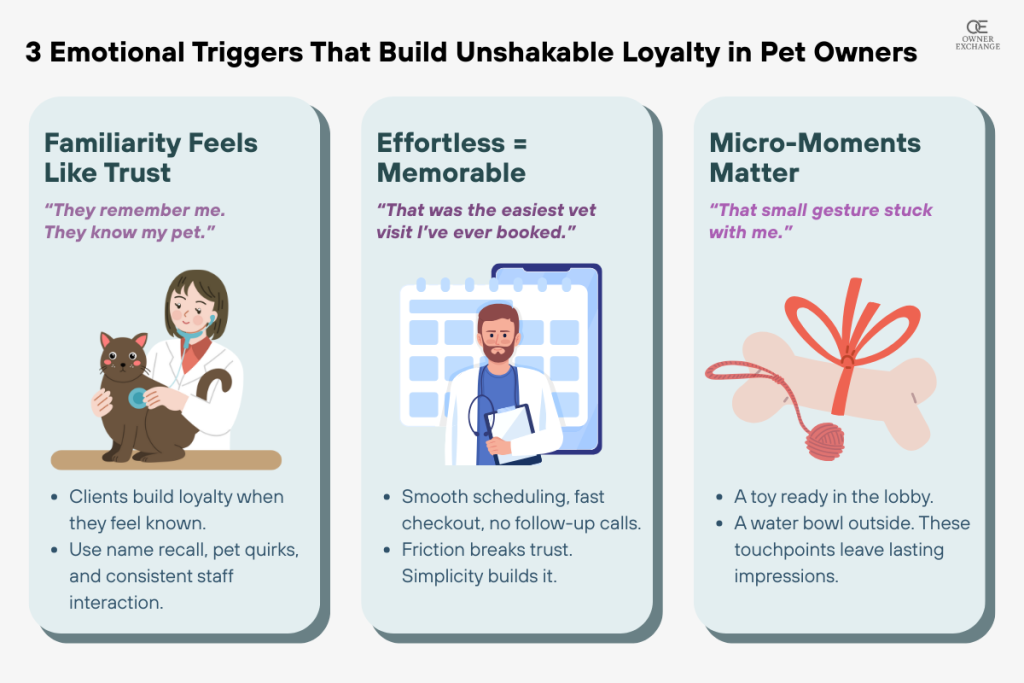
Many veterinary customer loyalty programs fail because they misread the emotional currency of the relationship. Loyalty isn’t about freebies. It’s about feeling remembered, being included, and having expectations met without friction.
And that’s where clinics often miss the mark.
They invest in reward systems that track spend, but not sentiment. They automate follow-ups but never personalize. They send generic wellness reminders, assuming they’ll resonate equally with the owner of a 9-month-old Labrador and a 14-year-old tabby.
3 Loyalty Triggers Clinics Often Underestimate
- Predictability: When care feels seamless and proactive, trust builds. Owners shouldn’t have to chase appointment reminders or vaccination dates.
- Recognition: A birthday email isn’t enough. Loyalty deepens when staff remember pet names, past concerns, or routines without being prompted.
- Reciprocity: Owners are more likely to rebook when their actions (compliance, feedback, referrals) are acknowledged. Not with discounts, but with relevance.
This explains why some clinics with modest pricing outperform fancier competitors on retention. They understand the invisible contracts being formed with every interaction.
If your practice wants to build retention that lasts beyond the offer, it needs to focus less on rewards and more on resonance.
This behavioral approach is increasingly being applied within broader veterinary leadership development initiativesnwhere team communication, tone, and follow-through shape loyalty far more than point systems.
Final Words
The most effective veterinary customer loyalty programs don’t compete on price or gimmicks. They build equity by strengthening how your clients feel about staying with your clinic. And that emotional anchor, when backed by thoughtful membership models, renewal logic, and client insights, makes your practice not just profitable, but transferable.
This is especially true when loyalty performance becomes part of your clinic’s sale narrative. It signals maturity. It signals repeatability. And for serious buyers, it reduces risk.
As you build or refine your loyalty systems, think beyond perks. Think about predictability. Think about what makes a client choose not to switch. Because in a consolidator-driven market, your retention engine may become the single most persuasive reason your clinic commands top-tier terms.
FAQs: Veterinary Customer Loyalty Programs
Predictable touchpoints, client recognition, and systems that reward consistency.
They solve different problems. Rewards nudge rebooking; memberships offer stability and long-term value.
Retention metrics give buyers confidence in future earnings and client stability, often influencing deal terms.
Yes, especially with follow-up logic, referral recognition, and continuity incentives.
Treating them as marketing campaigns instead of operational systems.
