
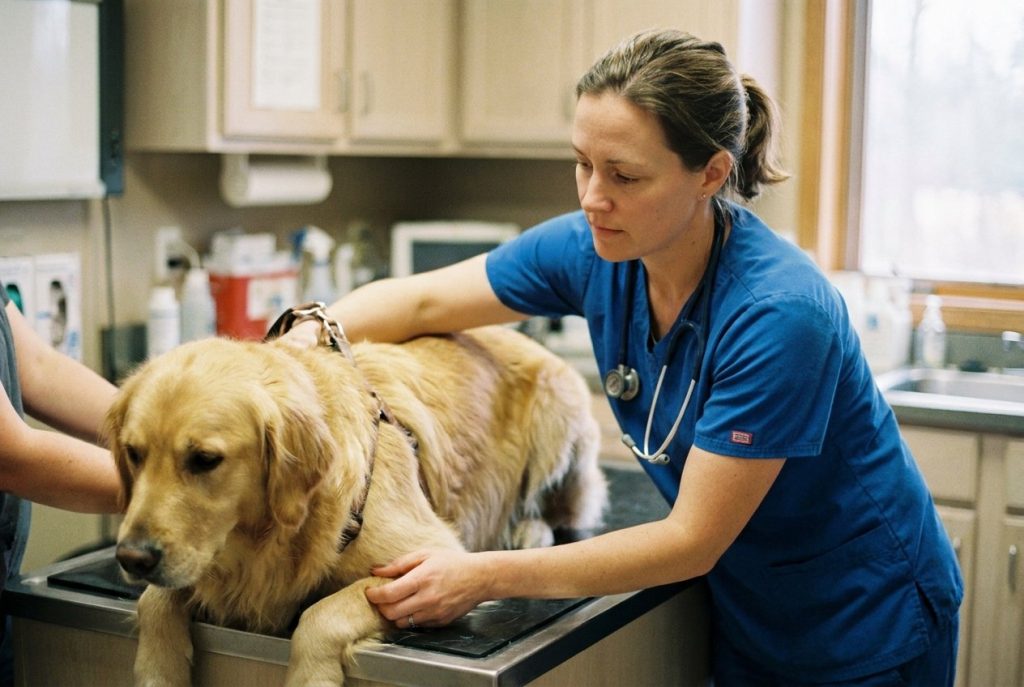
- It’s legally required almost everywhere once you employ people. Most states trigger coverage at the first employee. A few wait until 3 (Virginia) or 5 (Alabama, Mississippi, Missouri). Only Texas lets private employers opt out, and any multi-doctor practice is over the line.
- It’s priced per $100 of payroll, not as a flat fee. Veterinarians and technicians sit in class code 8831, which averaged roughly $0.93 per $100 of payroll nationally in 2025. The clerical front desk is rated far cheaper, if you classify it correctly.
- The rate is high because the work is. Veterinary services logged 10.6 injuries per 100 full-time workers in 2023 versus 2.4 for all industries (BLS). Bites, needlesticks, and lifting strains are the everyday exposures the policy exists to absorb.
- The durable discount is your experience modification factor. A documented safety program, clean payroll classifications, and active claims management pull that multiplier below 1.0, and a multi-doctor payroll makes every tenth of a point real money.
- Above $3 million in revenue, the stakes scale with payroll. OwnerExchange is the only community built exclusively for owners of 3+ DVM practices doing $3 to $10M and up, where peers compare exactly how they structure safety programs, classification audits, and their mod factor.
A few years back, an owner I know got her workers’ comp renewal and nearly spit out her coffee.
The number had jumped, and she couldn’t see why. Her practice was busy and profitable. Nobody had been seriously hurt. When she finally dug in with her broker, the answer was almost boring. Two small claims from the year before, a tech bitten on the hand and a doctor who tweaked his back lifting a sedated Lab, had nudged her experience modification factor above 1.0. That one decimal change was surcharging every dollar of payroll she ran through the practice.
She hadn’t done anything wrong. She just hadn’t been managing the thing as a system, the way she managed her schedule or her inventory.
That’s what this piece is about. Workers’ compensation is one of those costs owners treat as a fixed tax, when it’s actually one of the more controllable lines on the P&L. I help run a community of practice owners, so take everything here as general education, not insurance or legal advice. For your own coverage and your own state’s rules, talk to a licensed broker and your state agency. But the shape of how this works rewards understanding it before the renewal lands.
Is workers’ compensation required for a veterinary practice in 2026?
In nearly every state, the moment you have employees, yes. Most states require coverage at the first W-2 employee, with no minimum headcount. A small number set the trigger higher, and Texas stands alone in letting private employers opt out entirely. For a practice running multiple doctors and a support team, you are over the threshold in 49 states.
The exceptions are worth knowing if you’re near a border or thinking about a second location. Virginia requires coverage at 3 or more employees. Alabama, Mississippi, and Missouri wait until 5 or more. A few states carve out specific exemptions for owners, officers, or certain corporate structures, which is exactly the kind of detail a broker confirms for your entity. Independent contractors don’t usually count toward the threshold, but misclassifying a worker to dodge coverage is its own expensive mistake.
What workers’ compensation actually covers in a practice
Strip away the legalese and the deal is simple. If an employee is hurt or made sick by the job, the policy pays their medical bills and a slice of their lost wages, no matter whose fault it was. In return, the employee generally gives up the right to sue you over that injury. That trade, no-fault benefits for limited liability, is the whole point of the system.
In a veterinary setting, the everyday claims write themselves:
- Animal bites and scratches. The signature exposure. A frightened patient, a fast hand, a puncture that turns into a course of antibiotics or worse.
- Needlesticks and surgical sharps. Constant in a working hospital. A survey of veterinary technicians found 93 percent had a needlestick injury at some point in their career, and 74 percent in just the prior year.
- Lifting and restraint strains. Backs and shoulders, from hoisting a sedated large-breed dog or wrestling a fractious cat. These are the claims most likely to turn into lost time.
- Slips and falls. Wet floors, hosed-down kennels, the unglamorous physics of a busy practice.
- Zoonotic illness. Infections caught on the job. The CDC notes roughly 60 percent of known human pathogens are zoonotic, which is why an exposure at work is a real, coverable event.
Here’s the line owners blur most. Workers’ comp covers your employees. A client who trips in your lobby is a different policy entirely, that’s general liability. One is about the people who work for you. The other is about the people who visit. You need both, and assuming one covers the other is how practices end up exposed.

How veterinary workers’ compensation premiums are priced
This is the part most owners have never had explained, and it’s where the savings hide.
Your premium isn’t a flat number a carrier invents. It’s built from three inputs multiplied together: your payroll, the rate for each job classification, and your experience modification factor. Understand those three and you understand your bill.
Class codes and the per-$100 rate. Workers’ comp prices risk by job, using classification codes set by the National Council on Compensation Insurance (NCCI) in most states. Veterinarians, technicians, and animal-handling staff fall under class code 8831, the veterinary-hospital class. The rate is quoted as dollars per $100 of payroll in that class. Nationally, 8831 averaged about $0.93 per $100 of payroll in 2025, though it swings by state. Your purely clerical front-desk staff, the people with no animal contact, can often be split into a separate clerical class that’s rated a fraction of 8831. That split is one of the cleanest ways to shave a bill, and we’ll come back to it.
The experience modification factor. Once your practice is large enough, the insurer rates you, not just your industry. The experience modification factor (your “mod”) is a multiplier that compares your actual claims to the expected losses for practices your size. A mod of 1.0 is dead average. Below 1.0 is a credit that discounts your premium; above 1.0 is a debit that surcharges it. It’s calculated off a rolling three-year window, excluding the most recent year, so today’s claims follow you for years, in both directions.
Put it together and the formula is: payroll, times rate per $100, times your mod. Here’s how each piece behaves, and the lever you actually control on each one.
| What drives your premium | How it works | How an owner lowers it |
|---|---|---|
| Payroll | Premium is charged per $100 of payroll in each class, so a bigger team means a bigger base. | Not a place to cut. Instead make sure overtime and certain pay items are reported correctly so you’re not over-charged. |
| Experience modification factor | Your claims vs. expected, as a multiplier; 1.0 is average, and it’s the single biggest variable you influence | Fewer and smaller claims over a 3-year window pulls it below 1.0, a permanent discount on the whole premium |
| Claims management | Open, drifting claims cost more and inflate your mod for years | A fast, structured return-to-work program keeps an injury from becoming a lost-time claim |
Look at the bottom three rows. The rate you mostly don’t control, the state and NCCI set it. The mod and your claims handling you absolutely do. That’s the entire game for an owner: manage the inputs that feed the mod.
What it typically costs, with the honest hedge
Owners always want a number, so here’s a real, worked one, with the caveat that yours will differ.
Take a practice with 2 veterinarians, 3 technicians, and 1 receptionist. Put the doctors and techs in class 8831 and the receptionist in clerical. On a published Louisiana example, that practice paid roughly $4,169 a year, about $348 a month, with the vast majority coming from the 8831 payroll and only a few dollars from the clerical line. Change the state, the payroll, or the claims history and that figure moves.
Treat that as directional, not a quote. Premiums vary widely by state, payroll size, species mix, and especially your claims history, and a clean mod versus a debit mod can swing the bill by a third in either direction. A broker can price your exact situation, and on a multi-doctor payroll the difference between a 0.85 mod and a 1.15 mod is real money every single year.
The point for an owner isn’t the sticker. It’s that two practices with identical revenue can pay materially different premiums, and the gap is mostly earned, not assigned.
Why the veterinary rate runs higher than most offices
It helps to know why your rate isn’t cheap, because it explains where the savings come from.
The work is genuinely hazardous, and the data is stark. The veterinary services industry recorded 10.6 nonfatal injuries and illnesses per 100 full-time workers in 2023, according to the Bureau of Labor Statistics. The rate for all industries that year was 2.4. So a vet practice runs injuries at more than four times the all-industry rate.
The human numbers are just as pointed. Research cited by veterinary safety bodies estimates 50 to 67 percent of clinical veterinarians and up to 98 percent of veterinary technicians suffer an animal-related injury at some point in their careers. Insurers see that loss history, and they price it into class 8831. None of that is a reason to over-pay. It’s the reason a credible safety program pays for itself, because in a high-frequency environment, the practices that drive claims down stand out, and the mod rewards them.

The monopolistic states: a different system entirely
If you operate in four specific states, throw out the playbook above, because you can’t buy this coverage the normal way.
North Dakota, Ohio, Washington, and Wyoming are “monopolistic” workers’ comp states. In them, you cannot buy a policy from a private insurer or your usual agency. You must buy it from the state fund: North Dakota’s Workforce Safety & Insurance, the Ohio Bureau of Workers’ Compensation, Washington’s Department of Labor & Industries, and Wyoming’s Department of Workforce Services. Rates, classes, and rules are set by the state, not by NCCI.
There’s a trap in those four states that catches owners off guard. The state-fund policy does not include employer’s liability coverage, the part of a normal policy that defends you if an injured employee sues outside the comp system. To plug that hole, owners add stop-gap coverage, an endorsement to their general liability policy. If you run a location in one of these states, confirm you have stop-gap, because the state fund won’t sell it to you and a standard comp policy elsewhere would have included it.
How multi-doctor owners actually lower the premium
Now the part you can act on Monday. For a practice over $3 million with real payroll, three moves move the number, and they compound.
1. Build a real safety and return-to-work program. This is the big one, because it feeds your mod. Restraint training, sharps protocols, and lifting equipment cut the frequency of claims. A written return-to-work plan, light-duty for the bitten tech instead of weeks at home, keeps an injury from becoming a costly lost-time claim. In 2023, only 29 percent of recordable veterinary cases turned into days away, transfer, or restriction, and the practices that keep that share low are the ones whose mod drifts under 1.0.
2. Audit your payroll classifications every year. Money leaks here quietly. If a purely clerical receptionist with zero animal contact is sitting in class 8831 instead of the clerical class, you’re paying the animal-handler rate on the cheapest job in the building. At each annual premium audit, confirm every employee is in the right class and that overtime is reported correctly. An honest reclassification is found money, not a gimmick.
3. Manage open claims like they cost you, because they do. A claim that drifts open for a year inflates your reserves and your mod long after the employee is fine. Report promptly, stay in contact, get people back to suitable duty, and close claims fast. The owners who treat claims as an active file, not a thing the carrier handles alone, are the ones who keep the mod low year after year.
None of this requires you to become an insurance expert. It requires you to treat the premium as a managed system with three levers, which is a very different posture than opening the renewal and wincing.
Workers’ comp is one of the few P&L lines you can actively shrink, and most owners never try. Owners in our community compare exactly how they run safety programs, classification audits, and their mod, because the difference between a credit and a debit mod is pure margin. See how $3M+ owners manage this →
Why this gets sharper above $3 million in revenue
A solo owner with two employees and a $7 million, 5-doctor practice are managing fundamentally different exposure. More doctors, more techs, more payroll in class 8831, more claims surface area, and a mod that now swings thousands of dollars on a single decimal. The off-the-shelf “just get a policy” advice was written for the former and quietly costs the latter.
That’s the gap OwnerExchange is built for. It isn’t an insurance broker and it doesn’t sell policies. It’s a private community of owners running 3+ DVM practices doing $3 to $10 million and up, the sharpest 5 percent of independent owners, comparing the operating decisions that don’t have a textbook answer.
This is exactly that kind of decision. In the room, the conversation isn’t “do I need workers’ comp.” It’s how peers actually built the safety program that dropped their mod, which classification audit caught real money, how they handled the one ugly claim, and what their renewal actually came in at. You get a dozen owners’ real numbers instead of guessing against an industry average. Below a certain scale, a good broker and generic guidance will carry you. Above $3 million, with a payroll this size, the details get specific enough that a room of true peers is the difference between paying the assigned rate and earning the lower one.
What is OwnerExchange?
OwnerExchange is a private peer community for the sharpest 5% of independent veterinary practice owners: 3+ doctor practices doing $3 to $10 million and up. You join a small, caliber-matched mastermind POD led by a veterinary thought leader, plus a private 24/7 forum of owners who get exactly what your seat demands, from compliance and coverage to growth. No fluff, no vendors, no noise. A new group of just 12 owners is forming now.
We’re selective on purpose, and sometimes the honest answer after a conversation is “not yet.” The room only works when every owner in it belongs there.
Further reading
If you’re tightening up the business side of ownership, these go deeper on the decisions that sit next to your insurance lines.
- Veterinary financial planning: preparing your practice — how the strongest owners get the financial side of the practice in order, premium lines included.
- The challenges of veterinary practice ownership — the decision fatigue that makes unglamorous calls like this one harder alone.
- The veterinary practice owner community — who’s in the OwnerExchange room and how the PODs work.
Frequently asked questions
Is workers’ compensation required for a veterinary practice in 2026?
In almost every state, yes, once you have employees. Most states require coverage at the first W-2 employee. A handful set the trigger higher: Virginia at 3 or more, and Alabama, Mississippi, and Missouri at 5 or more. Texas is the only state where private employers can opt out. A multi-doctor practice is over the threshold everywhere except Texas.
How much does veterinary workers’ compensation insurance cost?
It’s priced per $100 of payroll by job class, not as a flat premium. Veterinarians and technicians fall under class code 8831, which averaged about $0.93 per $100 of payroll nationally in 2025, while clerical front-desk staff sit in a much cheaper class. Your actual cost depends on your state, your payroll mix, and your claims history.
What does workers’ compensation cover in a veterinary setting?
It pays an employee’s medical bills and a portion of lost wages for a work-related injury or illness, regardless of fault. In a practice that means animal bites and scratches, needlesticks, back and shoulder strains from lifting or restraining patients, slips on wet floors, and zoonotic infections caught on the job. It does not pay for a client who’s injured on your premises.
What is class code 8831 for veterinary workers’ compensation?
Class code 8831 is the NCCI classification for a veterinary hospital, covering veterinarians, technicians, and the staff who handle animals. It carries the practice’s main rate. Front-desk staff with no animal contact can sometimes be split into a far cheaper clerical class, which is why a clean payroll split matters to your bill.
Why are veterinary workers’ compensation rates relatively high?
Because the work is genuinely injury-prone. The veterinary services industry recorded 10.6 nonfatal injuries and illnesses per 100 full-time workers in 2023, against 2.4 for all workers, per the Bureau of Labor Statistics. Surveys find most veterinarians and nearly all technicians are hurt by an animal at some point. Insurers price that loss history into the rate.
How can a multi-doctor practice lower its workers’ compensation premium?
Three levers move it. Run a documented safety and return-to-work program so fewer claims turn into lost-time claims, which improves your experience modification factor over time. Audit your payroll classifications so clerical staff aren’t rated as animal handlers. And manage open claims actively. An experience modification factor below 1.0 is the durable discount.
Sources
Workers’ compensation classification, rating, and premium mechanics
- National Council on Compensation Insurance (NCCI). “ABCs of Experience Rating” — how the experience modification factor is calculated (1.0 baseline, credit vs. debit, three-year window). ncci.com
- WCIRB California. “Experience Modification” — experience-rating system, actual vs. expected losses, mod as premium multiplier. wcirb.com
- Kickstand Insurance. “Workers’ Compensation Insurance for Veterinarians Cost” — class code 8831 vs. clerical 8810, national average near $0.93 per $100 of payroll (2025), worked 2-vet/3-tech/1-receptionist premium example. kickstandinsurance.com
State requirements, thresholds, and monopolistic funds
- WorkCompOne. “Minimum Number of Employees for Workers’ Comp in Every U.S. State” — first-employee triggers, Virginia (3+), Alabama/Mississippi/Missouri (5+), Texas opt-out. workcompone.com
- Insureon. “Monopolistic Workers’ Comp States” — North Dakota, Ohio, Washington, Wyoming; state-fund-only coverage; employer’s-liability gap and stop-gap endorsement. insureon.com
- The Hartford. “Monopolistic States for Workers’ Compensation” — state-fund mechanics for ND/OH/WA/WY. thehartford.com
Veterinary occupational injury and hazard data
- U.S. Bureau of Labor Statistics. “Nonfatal injuries and illnesses in the veterinary services industry” (The Economics Daily, 2025) — 10.6 cases per 100 FTE in 2023 vs. 2.4 for all workers; 29% resulted in days away/transfer/restriction. bls.gov
- U.S. Bureau of Labor Statistics. “TABLE 1. Incidence rates of nonfatal occupational injuries and illnesses by industry and case types, 2023.” bls.gov
- CDC / NIOSH. “Hazards to Veterinary Medicine and Animal Care Workers” — animal bites, needlesticks, lifting strains, zoonoses (≈60% of human pathogens are zoonotic). cdc.gov
- Weese, J.S. et al. “A survey of needle handling practices and needlestick injuries in veterinary technicians” (PubMed) — 93% career and 74% prior-year needlestick injury rates. pubmed.ncbi.nlm.nih.gov
- Fowler, H. et al. “Work-related Injuries to Animal Care Workers, Washington 2007–2011” (PMC) — animal-contact injury mechanisms and frequency. pmc.ncbi.nlm.nih.gov
- American Veterinary Medical Association. “Hurt at work” (JAVMA News) — injury frequency in the profession and the case for workplace safety programs. avma.org
